Validate
Check mode, model, duration, output, references, audio, and budget.
One video generation API
Send text, images, references, output settings, and a spending limit through one request shape. Choose the model yourself or route by the requirement.
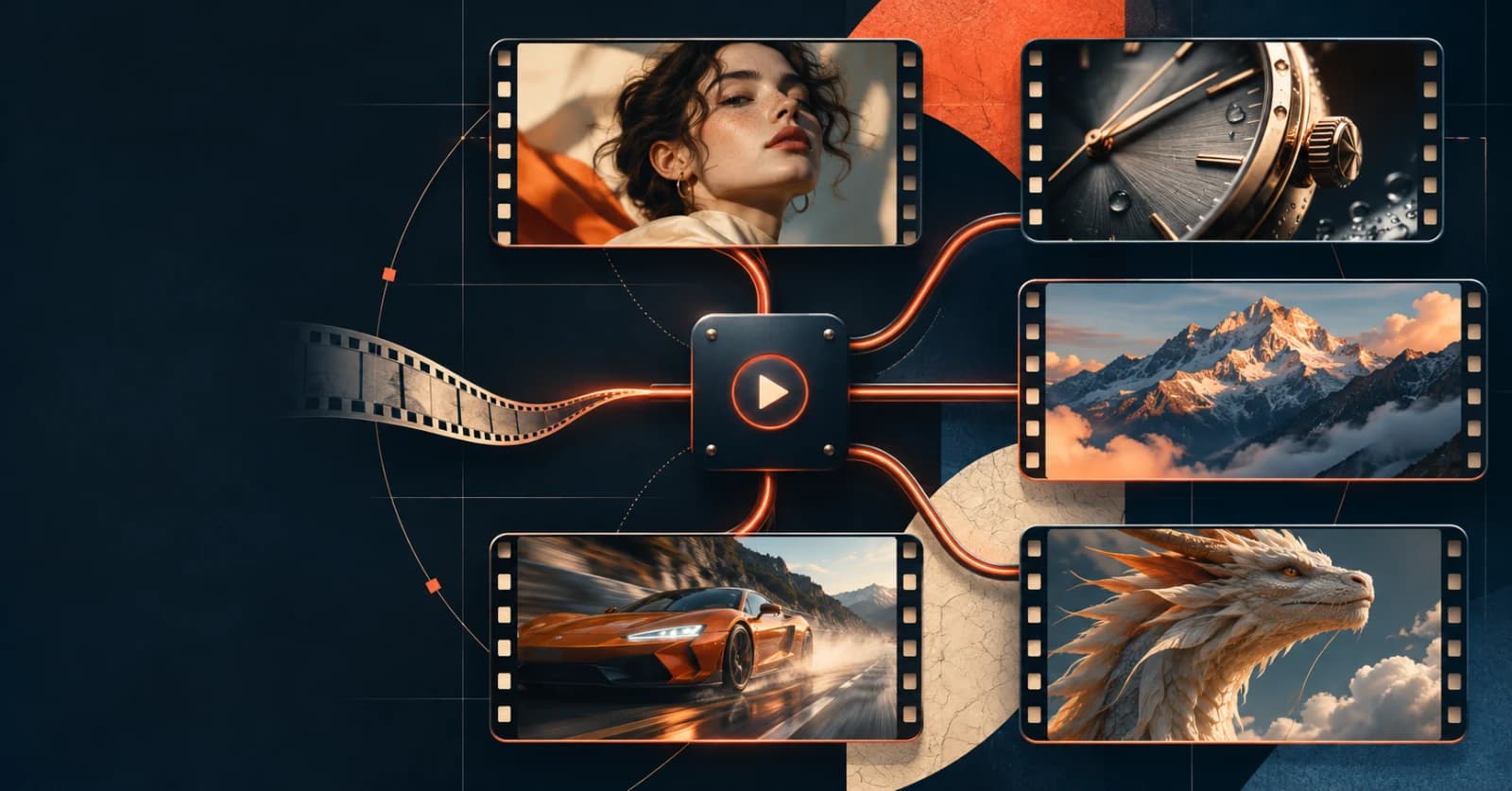
Route matrix
These listed starting routes cover cheap drafts, controlled motion, reference-led work, native audio, and premium review output.
| Goal | Route | From | Best use |
|---|---|---|---|
| Lowest cost | Wan 3 | $0.025/s | Fast drafts and budget batches |
| Reference-led | MiniMax H3 | $0.029/s | Low-cost motion from approved media |
| Controlled motion | Kling 3 | $0.039/s | Prompt following and image animation |
| Native audio | Veo 3.1 Fast | $0.049/s | Picture, dialogue, effects, and ambience |
| Premium route | Seedance 2.5 | $0.069/s | Higher-cost review output |
Job lifecycle
Check mode, model, duration, output, references, audio, and budget.
Return the exact unit rate, total, assumptions, and estimate expiry.
Start one idempotent job under the approved maximum cost.
Expose queued, running, completed, failed, and cancelled states.
Deliver output, route, normalized settings, and final charge.
Video API questions
It lets software create video from text, images, references, or existing footage through structured requests. The API accepts the prompt and output settings, creates a job, reports status, and returns the final video and cost data.
Read the full answer →Yes when the application uses normalized common fields and keeps model-only controls in an extension object. The route can change while the job, status, error, cost, and result contracts stay stable.
Read the full answer →Most routes price generated seconds, but the exact rate can change with model, resolution, audio, input mode, references, queue speed, and duration. Estimate the full request before submission and include retries when planning usable output cost.
Read the full answer →Choose by the input mode, output quality, motion and prompt control, audio, reference support, job reliability, latency, pricing, and the amount of provider-specific code your product must maintain.
Read the full answer →Many APIs support both text-to-video and image-to-video, while some also accept first and last frames, multiple images, video references, audio, or existing footage. The supported combination depends on the selected model and route.
Read the full answer →Price the route
Primary sources